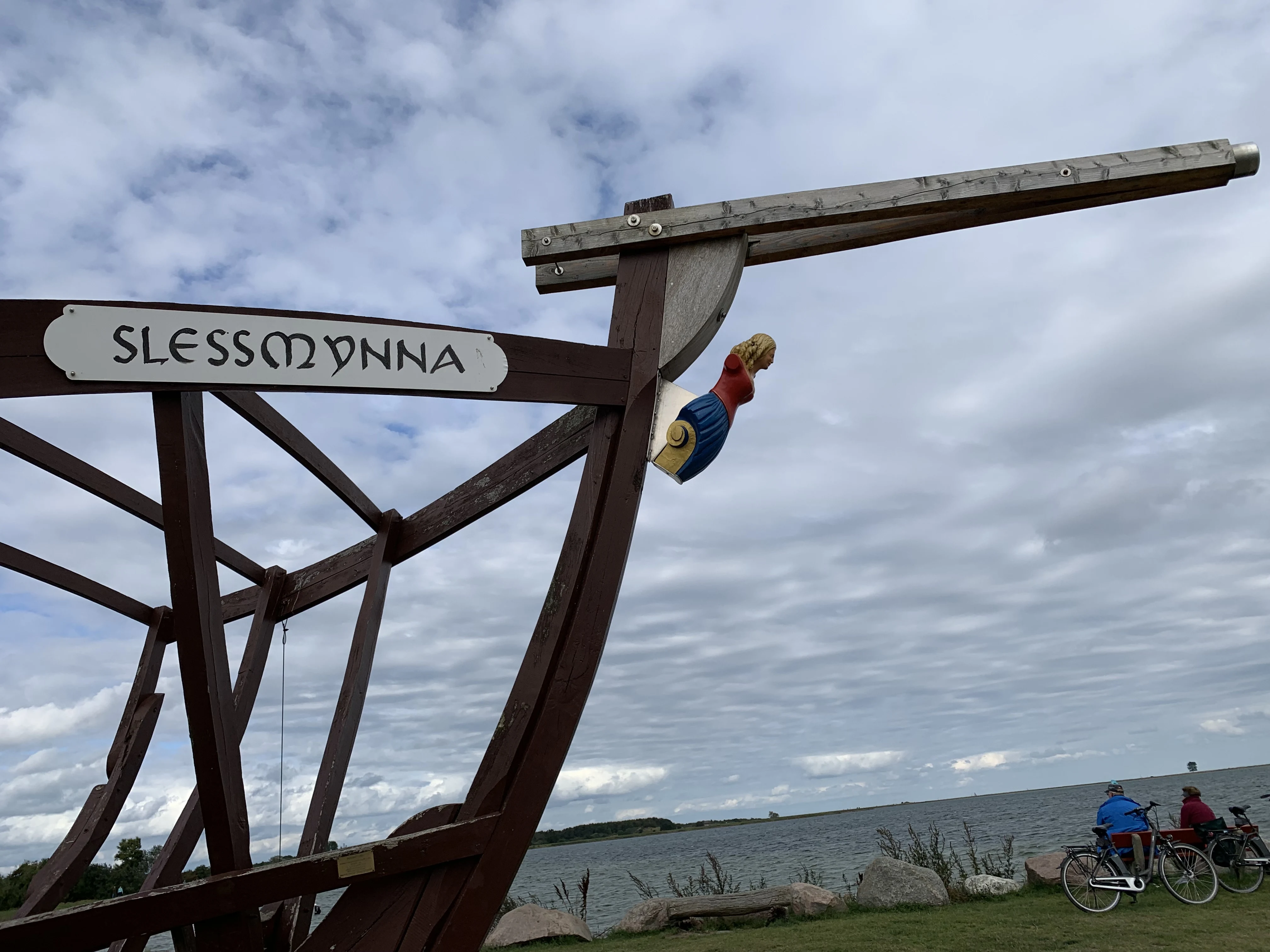
Some timber beside the water, a name that requires a preparatory breath: you quickly think of Vikings. I did too. They are the relief staff of the northern German imagination. Whenever a beam appears beside a coast, they are expected to have been involved.
Here they may go home again. The bow is a modern harbour sculpture. A local account names the Jaich company as its donor, harbourmasters Petersen and Hoffmann as its builders, and boatbuilder Löchelt as the figure's carver. Her name recalls an old designation for the mouth of the Schlei.1
What stands before us is therefore no excavated ship. It is something that looks capable of beginning a story.
And it is.
01
The water had a key
Maasholm owes its location to a decision that should make sense to anyone who has lived on the ground floor: if the water enters the house often enough, eventually someone has to move out.
The regional tourism organisation's historical walking guide says that repeated flooding led to the relocation of the earlier settlement of Maas, near the former mouth of the Schlei, to the higher site of Maasholm in 1701. A causeway connected it to the mainland.2
It reads so tidily. Village here, flood, village there. Three lines and the job is done. An ordinary house move occupies rather more space in the family memory, although it seldom requires the entire settlement to come along.
Behind that sentence are people. Homes, work, neighbours, things they hope will function again somewhere else. And the unwelcome recognition that it may be unwise to expect the old place to become more reasonable next time.
They could not go far. The inhabitants initially lived by seafaring, and later chiefly by fishing. At times towards the end of the nineteenth century, more than 150 professional fishermen sailed from Maasholm.2 They needed the water. Just not in bed.
So they moved far enough away to live more dryly, while remaining close enough to work. It was a compromise with a party that did not attend the negotiations.
Today, “right on the water” sounds like a feature for which you pay extra. In this history, it was occasionally a feature for which you needed a new village. The wording has improved considerably. The water remains.
02
A post does not make a speech
Along the western shore of the Schlei are the historic Kahnstellen: wooden landing places for the small fishing boats. Their posts also served for drying nets. The 2017 guide records 48 surviving berths under heritage protection, restored in 2011.2
It is easy to walk past a post. It makes little effort to prevent you. No heroic pose, no gaze towards the distance. A post has accepted that it only looks slimmer from the appropriate range.
But everyday life hung from these. Tie up the boat, dry the net, go out again tomorrow. People working that way needed things that held. The attractive effect of weathered timber was presumably not a leading concern.
That is what interests me about these landing places. They speak of work without retrospectively pretending that work was always a picturesque leisure activity. The harbour was somewhere you had to make a living. The weather was not an opening for conversation. It could decide whether you went out at all.
The woman at the bow is more likely to get a photograph. The posts explain why there is a harbour in front of which to photograph her.
03
The coast revises its own map
Maas and its move do not finish the story. At the mouth of the Schlei was another, older place: Mynnaesby, also called Slaesmynnar.
In an essay published by the Kappeln town archive, Hans-Peter Wengel describes a medieval trading and toll settlement mentioned in King Valdemar's land register of 1231. Beside it stood a fortification called Oldenburg or Gammelborg. In his account, the village's precise location is uncertain; possibly it occupied an island that has also disappeared.3
Maas and Mynnaesby are different settlements. I would happily compress them into a single story, since that would mean fewer names to look up. Unfortunately, the story would then be wrong.
The second place belongs to the older estuary landscape. Wengel recounts reports of masonry becoming visible when the water was exceptionally low. This is historical testimony, not an invitation to visit. We should not expect an exposed village street with someone selling smoked fish at the far end.3
It is still an odd thought: the same stretch of water whose chief requirement in a holiday photograph is to look attractively horizontal holds a history whose ground we can no longer reliably point to.
A trading place means people arriving, moving goods, paying, waiting and leaving. Their individual voices are absent from this brief account. The settlement can be documented; the exchange at its toll point would have to be invented. As a writer, I could certainly be useful for that. As a companion through this history, rather less so.
The entrances to the Schlei also shifted and silted up. Wengel dates the construction of the present entrance to 1794–1796.3 Even the door to the water did not remain where someone had once drawn it.
We like to think of coastlines as lines. Land on the left, sea on the right, a sensible edge between. On a map this works beautifully. The coast, however, owns neither our atlas nor any discernible desire to abide by it.
The Slessmynna faces Schleimünde, not an exactly established site of the lost village. That open gaze suits the place. There is more past here than there are fixed points to which we could bolt it.
04
A cross with a second life
Another thread leads to the Petri Church. Before Maasholm acquired its own church, the inhabitants sailed to Kappeln for worship, sometimes in considerable danger. The dead were also taken by water to the cemetery there. Later, devotions took place in the school; the village's own church was consecrated in 1952.4
The Schlei therefore ran through the whole of life. Work, worship, burial: what we now regard as a view was also the route by which this community came together.
And above the altar is the Cross of Hope. Heinrich Petersen, a master painter born in Maasholm, carved it for his mother's grave in Kappeln. After the grave was removed, the cross went to the worship room in the Maasholm school. Pastor Ottemann had it restored and installed in the church.4
That small journey stays with me more than some grand dates do. Someone made something with his hands for his mother. When its first place was gone, it was kept, passed on and put up again. A private remembrance acquired a place in a shared room.
Places altered by water, a village at a new site, a cross with another purpose: there is no need to force them all to mean the same thing. It is simply striking how much survived here because it did not have to remain where it began.
The church history contains another sentence that makes me warm considerably to the building: community events require somewhere to make tea and coffee.4
There are descriptions of spaces, altars, light and the great hope of humanity, and eventually someone returns to the decisive question: where shall we put the kettle?
I like that. A community also consists of people who stand up after sitting down and would like to stay a while. A warm cup and a chair you can move help with this. Neither gets many monuments. Both are missed as soon as they are absent.
05
The woman stays
Back to the open bow. In the side-on photograph, two people sit on a bench beside the water, their bicycles next to them. They face the same way as the figurehead. I do not know what they are thinking. Perhaps the medieval toll settlement matters a great deal to them. Perhaps they would simply like to sit for another five minutes.
The village website, incidentally, has a practical message for those returning from a long spell at sea: there is a hairdresser in Maasholm.5 It is difficult to contemplate a coastal landscape with entirely unqualified longing when someone simultaneously informs you that something can be done about your head afterwards.
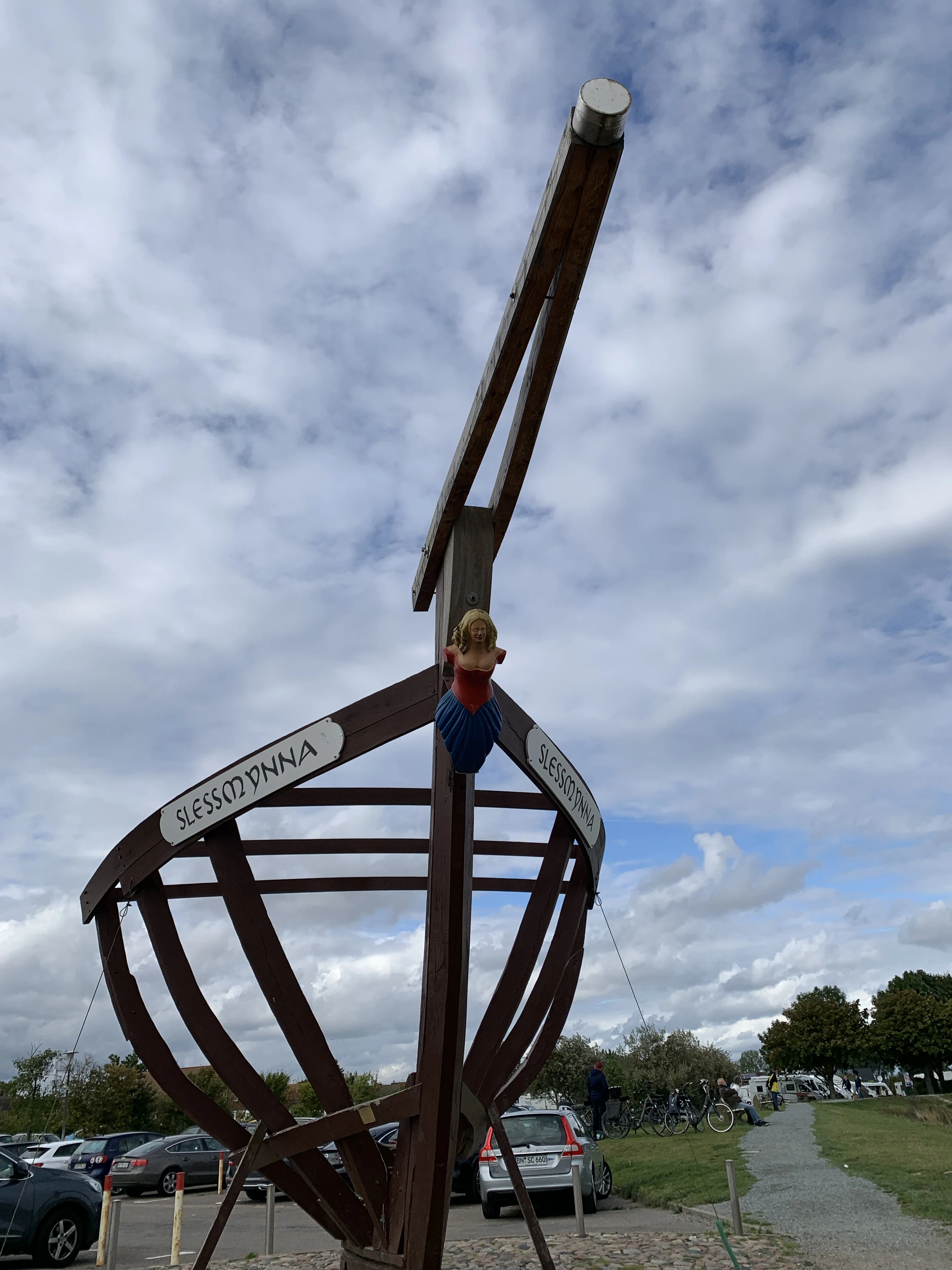
The woman at the bow seems to have no immediate need. Her hair holds. Her ship does not sail. Sky, cars, trees and the present fit through its open ribs without anyone stopping them at the entrance.
The Slessmynna asks little. A brief pause between the car park and the water will do. The timber becomes questions; the view becomes a place where people had to move, passages were relocated, and things were kept for which there was no future at the old address.
The woman says nothing about it. She keeps looking outwards.
A whole ship might have left by now. This half is still here.