According to the local preservation association, one reason it is still here is that the town could not afford to demolish it.
That deserves a moment. We are accustomed to heritage surviving through foresight, devotion and somebody standing firmly in front of a bulldozer. Here, at least for part of the story, the decisive contribution appears to have been an unaffordable quotation.
History occasionally owes a debt to the person who opens an envelope, looks at the price and puts it back in the drawer.
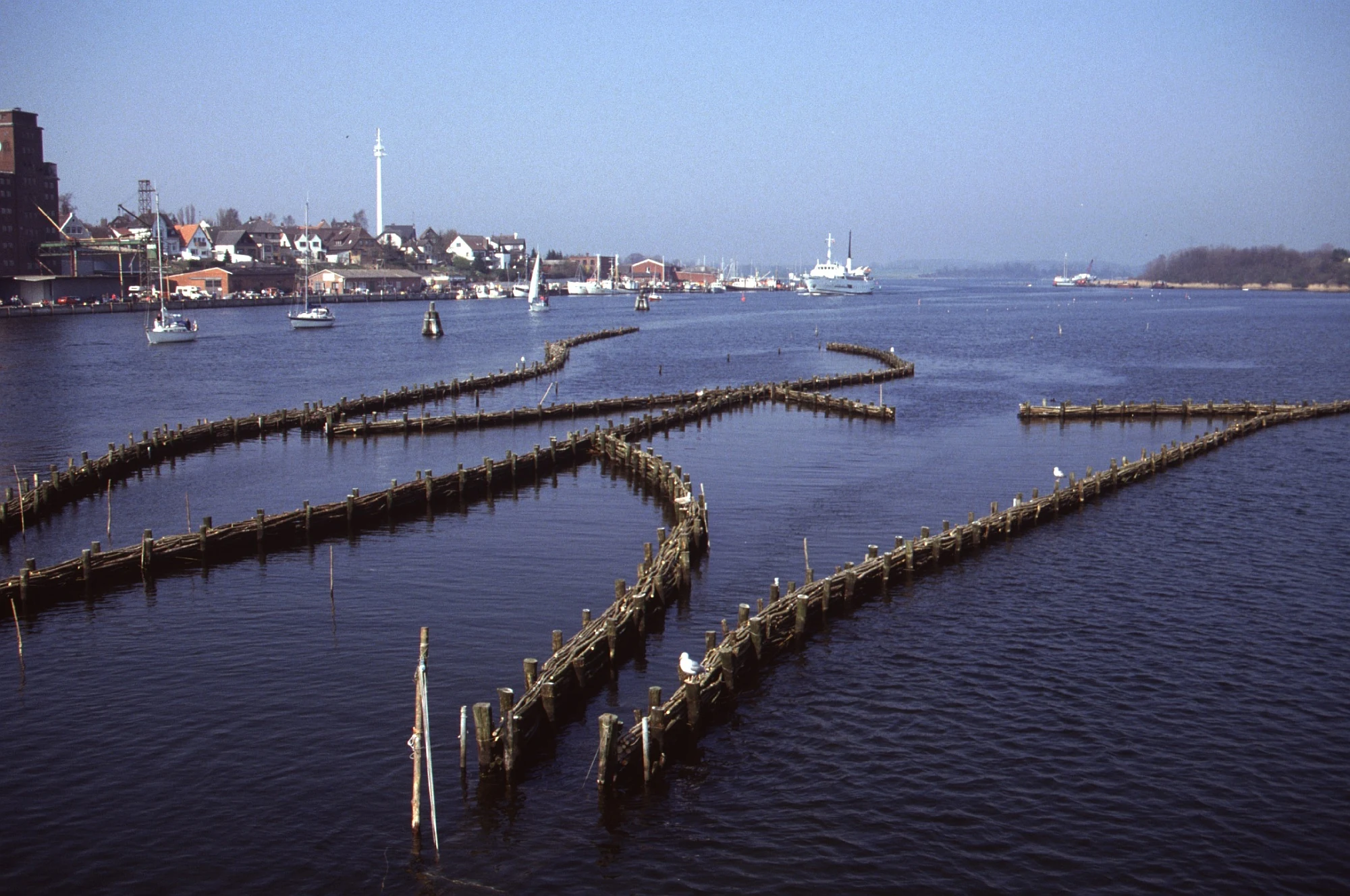
The fence began with a more practical purpose. Its arms converge through the water, directing fish towards traps. Posts and woven material form barriers; the herring follow the route until the arrangement becomes considerably less favourable to the herring.
It is an ingenious piece of work. Much of the persuasion has been completed before the fisherman arrives. The fish supplies the movement and the fence supplies the regrettable conclusion.
From the bank, it looks passive. But there is a difference between doing nothing and being positioned so that other things do the work for you. A well-placed fishing fence belongs firmly in the second category.
It also requires a right to put it there.
This is where the agreeable harbour view begins to develop a temper.
A historical account hosted by the city of Kappeln describes long disputes between the noble landowners along the Schlei and the fishermen of Schleswig’s Holm. Landowners built and extended fishing fences. Holmer fishermen were driven away and their nets taken. The water may have been shared by the landscape, but sharing its proceeds was another matter.
A row of posts could determine who caught the fish. To the owner, that was an excellent arrangement. To a fisherman whose livelihood lay beyond the barrier, it offered fewer opportunities for admiration.
There were boats to consider as well. The historical account reproduces a seventeenth-century passage concerning the surveying and regulation of the fences, including the need to keep a channel open for shipping. Eventually, the competing interests had to be measured.
It is reassuring to discover that an argument can become so old that someone brings a surveyor.
Behind this lay work, food and households that needed income. A stolen net was equipment taken from somebody who depended on it. We can enjoy the absurdity of a picturesque fence acquiring administrative importance without forgetting what made people angry in the first place.
The Holm and Kappeln belong together in this history. The fishermen upriver and the fences downstream occupied different positions in the same system. What looks like a quiet feature of one town’s view reaches along the Schlei into another community’s working life.
A photograph allows everyone to sit peacefully in the same frame. History is less accommodating.
As fishing practices changed and the old fences declined, Kappeln’s surviving structure entered a difficult period. It had become inconvenient without yet becoming indispensable to the town’s idea of itself.
This is a dangerous age for anything made by human beings. Its original users have moved on; its admirers have not yet organised a committee. Someone begins a sentence with “Surely we could just…”
The city-hosted history records renewed negotiations in 1910 to acquire the fence because it posed a danger to the pontoon bridge. An agreement was reached, but the expense of demolition defeated the plan.
The local preservation association tells that survival story with understandable gratitude. It is worth keeping the attribution attached. A history this long has more causes than can be fitted onto one invoice. Still, the unglamorous detail is part of what makes the fence interesting. There was a point at which removing it seemed desirable, and paying to remove it seemed considerably less so.
For an object facing extinction, becoming the cheaper option is a useful defensive manoeuvre.
Later, people chose to keep it.
The historical account records an appeal from Ellenberg schoolchildren before the city took responsibility in 1977. There is something moving about children entering the argument on behalf of a structure adults could regard as obsolete. They were asking the town to carry something forward.
A thing need not look impressive to matter to the people who grow up beside it.
The preservation association recalls the restored fence being celebrated in 1978. The first Kappeln Herring Days followed in 1979. The awkward old fishing apparatus had acquired a public occasion. People could gather around its continued existence, and help sustain it.
It is quite a promotion for a fence once considered a nuisance.
The work did not end with the celebration. There is always a temptation to imagine preservation as a single victorious afternoon: the decision made, the ribbon cut, everyone home before rain. A wooden structure standing in moving water has other plans.
Kappeln’s current restoration account describes shipworms hollowing out the supports. The fence was rebuilt in two phases, the second completed in June 2026, using eucalyptus posts more resistant to the damage.
A cultural monument has to survive the appetites of creatures that have never attended a council meeting and see no reason to start. You can explain the historical significance of a post at considerable length. The animal inside it will continue with lunch.
New wood takes the place of old wood. Labour and money keep the shape visible. The tradition survives because people return to it with materials and tools.
That makes this a particularly honest sort of monument. It cannot pretend to be untouched. Its survival involves replacement, argument, fundraising and the repeated discovery that water is hard on things.
What persists is the arrangement: the way the barrier meets the current, the method it represents, the connection to people who made their living here. Each repair renews the town’s decision that this belongs in the view.
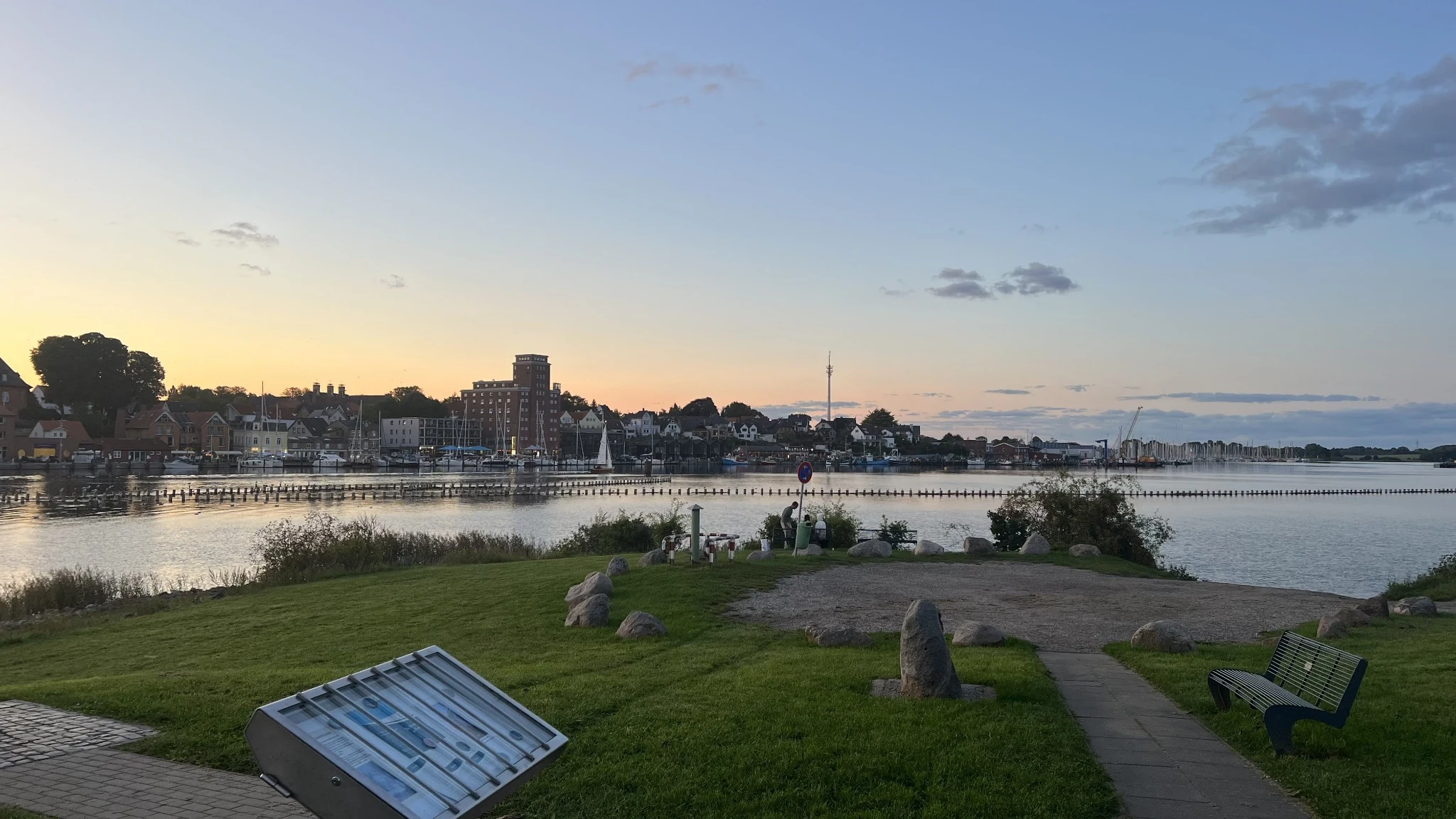
Look again at the photograph. Across the Schlei, Kappeln still has its boats and its waterfront buildings. The evening light has not been troubled by any of this. The low posts remain easy to miss.
But now there are fishermen behind them, and noble owners, and a bridge that needed protecting. There are children asking adults to keep something. There are volunteers and invoices, replacement timber and creatures determined to eat it.
All that in a feature of the landscape that barely raises its head above water.
The town once found it too expensive to remove. Later, it found reasons to pay for its survival.
The fence has remained in approximately the same place while the argument around it has changed completely. For a line of wooden posts, that is a rather accomplished career.