At the mouth of the Schlei, where the long Baltic inlet opens to the sea, Schleimünde occupies the southern end of a narrow strip of coast. The old channel farther north silted up; the land joined on.1 The name stayed. Visitors still arrive by water, because the landward approach crosses a protected nature reserve.14 Geography has connected the place; access has remained an entirely separate discussion.
I rather like this arrangement. A name remembers something a map no longer shows. It is a small resistance to the administrative urge to bring everything up to date, usually by making it less interesting.
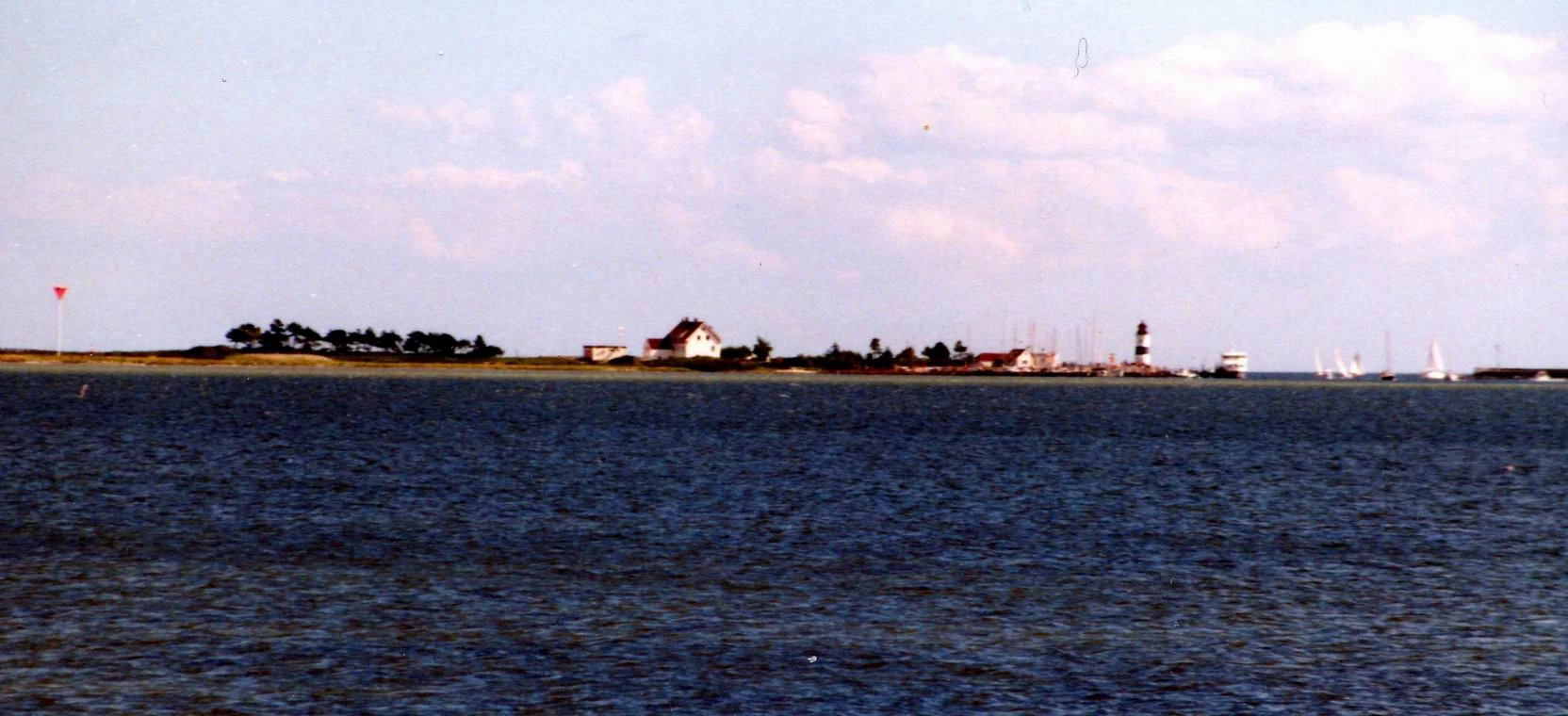
In an old photograph, the place seems almost insufficient for the sea around it: a low line of land, a few roofs, the pilots’ house, a lighthouse. There is a great deal of sky. Looking at it, I can understand the temptation to call Schleimünde timeless, which is what we tend to call a place when we have not yet read its maintenance records.
Then you read them.
01
A door the sand kept closing
The entrance to the Schlei is partly an argument with sediment. Material eroded from the Schönhagen cliffs to the south travelled along the coast and helped build the spits that narrowed the opening. During the late eighteenth century, a new passage was cut south of the Lotseninsel to preserve navigation. The local geological account places that work across 1780–1796; other histories give narrower dates for individual stages.2
Sand is a remarkably persistent opponent. It needs neither a committee nor funding. Once we have finished a channel and announced it finished, sand can begin again that evening.
This is worth remembering when looking at a lighthouse. The tower is the visible part of an agreement between mariners and a coast that will not quite hold still. Before anyone can admire the lamp, somebody has to keep an entrance beneath it.
The pilot’s task belongs to that less visible world. A chart gives you information. Local knowledge tells you how much confidence to place in it. The island’s name preserves a profession whose usefulness depended on knowing what other people could not see.
Even the older history occasionally surfaced with the seabed. A local historical essay records the pilot Lischke’s observations of masonry and burials exposed at low water in 1802. These are reported observations, not an invitation to draw a complete vanished town. It also preserves a legend: one of Gelting’s bells sank while being unloaded at Schleimünde; its companion’s ringing remembers it.3
There is room for the legend without asking it to serve as archaeology. A lost bell is a good story; it becomes a rather less good excavation report.
The archaeological literature is more cautious still. A 2001 research report discusses possible ship barriers and the elusive settlement name Mynnaesbu, recorded in 1231. Proposed connections between wreck remains and a blockade in 1417 carry qualifications.4
Those small question marks deserve to survive. Beneath a changing coastline, absence can mean several things: washed away, buried, misplaced in an old account, not yet understood. I find that more compelling than a tidy drawing of a medieval harbour furnished with citizens nobody can substantiate.
02
A house with two jobs
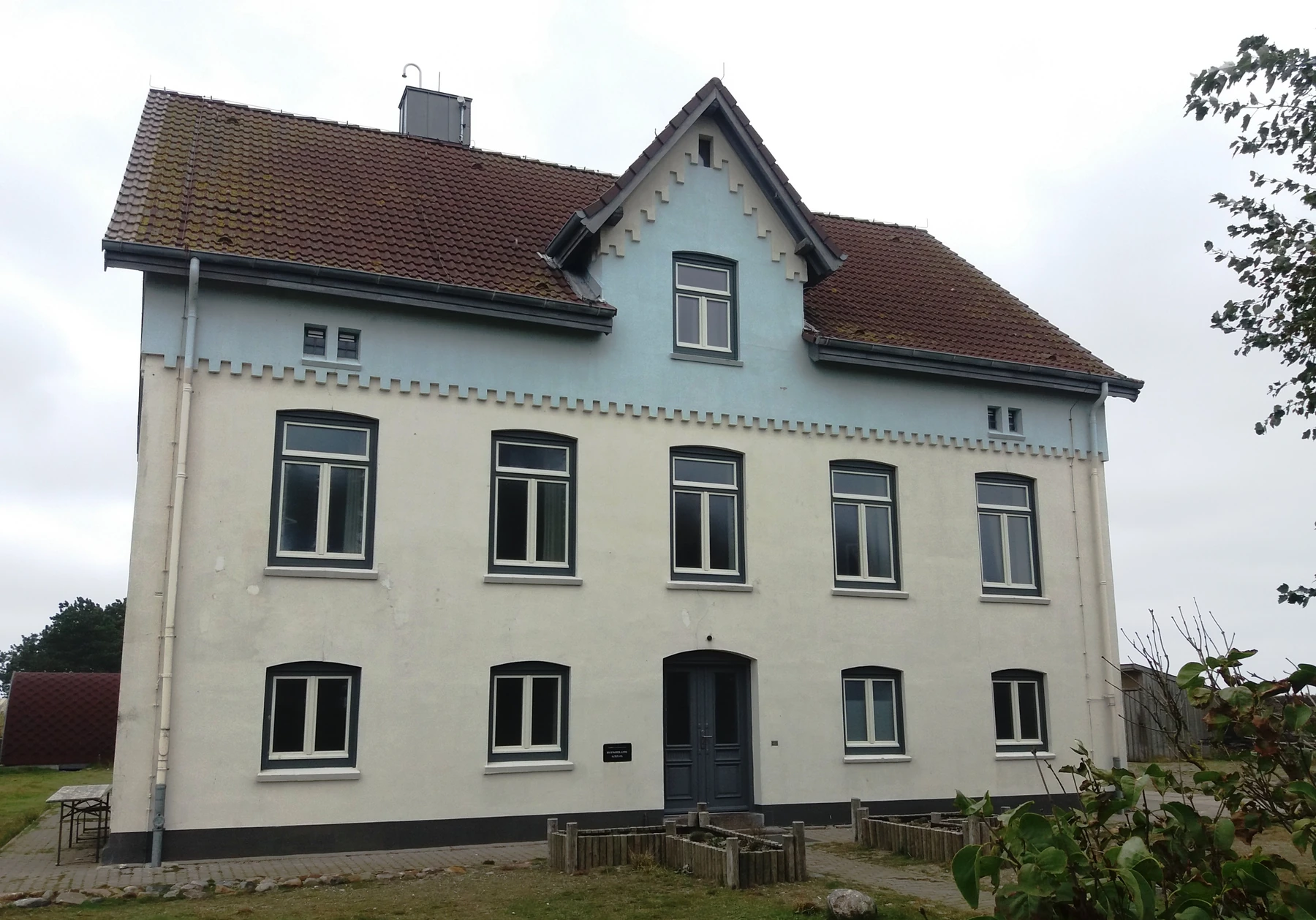
The pilots’ house is substantial enough to interrupt the horizon. In the 2020 photograph, its windows line up beneath a tiled roof and an emphatic central gable. It looks like a building with responsibilities. Even its front door appears to expect a sensible explanation for your arrival.
A notice to mariners from December 1873 announced a new pilots’ house, describing yellow brick and a thatched roof. It could also serve as a landmark.5
That second job is easy to miss. We look at a house and think of people inside it. A mariner could look at the same house and use it to establish where he was. Shelter for one person became information for another. The building was allowed to earn its keep twice.
According to the harbour association’s history, the pilots remained stationed here until 1980.6 The name has outlasted that arrangement too. The old profession is gone from the house, but it still provides the place with an identity rather more distinctive than a resort committee would be likely to invent.
03
The lighthouse gets dressed
The present lighthouse dates from 1871. The waterway authority’s historical account gives 16 November as the day its light was first lit. Built of yellow brick, it acquired its green-and-white appearance through the refurbishment begun in 2014. The green identifies the starboard side of the approach channel.7
It is a pleasing colour scheme, but its purpose is to tell somebody where to put a boat. This is an excellent qualification for beauty. I would be more sympathetic to certain modern buildings if their colour helped me avoid a sandbank.
The tower has changed its appearance repeatedly. One surviving notice records a particularly modest interruption to its wardrobe: the red-and-white chequered paintwork planned in 1920 had to be stopped, leaving a white base coat until the following spring.5
I had not expected to find an unfinished decorating job among the important documents of maritime history. It makes the lighthouse much easier to recognise as a human undertaking. Someone had to tell ships that the reassuring landmark was temporarily wearing its undercoat.
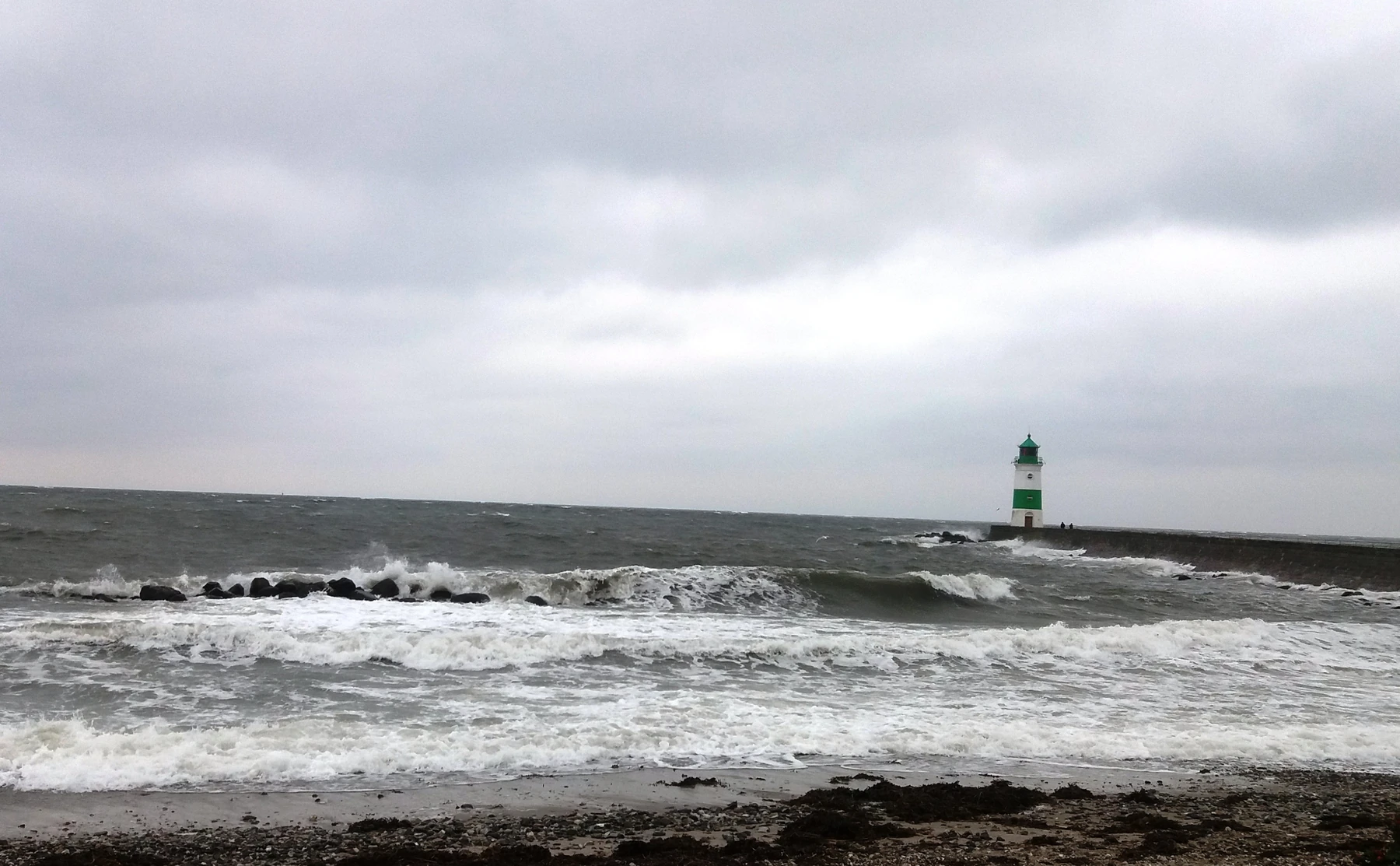
The photograph from October 2020 offers a less agreeable assessment of the setting. The sea is grey and broken; white water runs over the stones. The green band is small against the sky. There are figures beside the tower, reduced almost to punctuation by the amount of weather.
That photograph is six years old as I write. It records neither the flood of 2023 nor the condition of the works today. It does, however, discourage the idea that the lighthouse is merely a decorative object placed at the end of a pleasant stroll.
04
Seventeen hours upstairs
On 13 November 1872, a storm surge overwhelmed the coast. Schleswig-Holstein’s account records thirty workers, employed on a mole, sheltering with the lighthouse keeper’s family in the attic of the pilots’ house for seventeen hours. The ground floor was destroyed and the roof structure began giving way. The keeper himself was trapped in the new lighthouse.8
This is where the dimensions of the place change. The little roofs on the horizon contain people waiting for water to fall. A tower that looks close enough in a photograph is beyond reach.
I cannot tell you what they said to one another. The record supplies no conversation, and the situation does not need improving by a writer. Thirty workers and a family, seventeen hours, a house being damaged beneath them: there is already more than enough to hold in mind.
The flood account and the 1873 new-house notice do not establish that the refuge was the building photographed above.58 We should not fold two records into one convenient set of walls.
The uncertainty is about the building, not the fear. Waiting upstairs while the sea attacks a house is an experience whose meaning travels quite well without an exact floor plan.
05
An alarming name for refreshments
Then there is the Giftbude. To an English reader, the name initially sounds generous. To a German reader encountering it without context, it suggests poison. Between us, we have managed to make a small coastal eating place sound like either a charity or an investigation.
The harbour association explains the old coastal word through the earlier sense of Gift as a gift or something given. I would let that explanation do its work before ordering.9
The name is better known than the distinction between its buildings. The original Giftbude ceased its regular catering operation after the October 2023 flood. The historic building survives as a shelter and occasional event space. Since 2025, the lütte Giftbude—the little Giftbude—has offered refreshments beside the harbour office.9
That is a change worth naming precisely. If you tell people the old building vanished, they will misread what is still there. If you tell them the old pub is carrying on as before, you will misread what was lost. A familiar name can carry on while the life behind it changes.
There is a further practical detail in the foundation’s report: the flood destroyed the kitchen containers attached to the old operation.10 The modest structure in a holiday photograph had depended on rooms and equipment that the photograph could easily leave out.
We rarely put a storeroom in the centre of a picture. Its absence becomes much more interesting when it prevents lunch.
06
Keeping a place available
In winter 1997, the harbour faced closure. Water-sports clubs and conservation interests helped form the association that kept it open.6 I am always interested in this stage of a place’s history, when affection must become something capable of repairing a jetty. A fond memory is a start. Eventually somebody has to turn up with tools.
In 2008, the Lighthouse Foundation acquired the property from the federal government.6 Its account gives the purchase price as €655,000 and explains the concern that a private buyer might not preserve public access.11
The important purchase, to my mind, was the possibility of continuing to go there. A visitor sees an open door without seeing the decision that kept it open. Access can look as natural as the beach once the paperwork has been put away.
The October 2023 flood made the work visible again. The foundation’s 2024 report describes damage to water and wastewater systems and the restoration of essential services.10
NDR’s account of the rebuilding describes pupils and teachers from the Ostseeschule Flensburg helping alongside volunteers. It reports months of clearing up and the carrying and stacking of 130 tonnes of stone.12
That figure makes me pause. It gives an otherwise comfortable expression—learning outside the classroom—a weight. I will not invent what any pupil thought of the work. I can say that a wall assembled by hand represents a different acquaintance with a coastline from the one acquired by photographing it.
There is a quieter detail in the foundation’s volunteer accounts. Paulina lists cleaning the Giftbude, cleaning bathrooms, bringing in beach chairs and, especially, carrying heating pellets.10
The pellets are the detail I keep returning to. They are awkward, ordinary and necessary. They will not appear on the souvenir mug. Yet they bring the island closer than a dozen sentences about escape: someone wants the rooms warm, and somebody else must move the fuel.
07
The land you leave alone
North of the visitor area is the Schleimündung nature reserve, established in 1927 and enlarged in 2011. Jordsand describes its significance for breeding, resting and wintering birds. The protected shore is not open for independent wandering; guided visits are the way to see parts of the reserve.1
It is a useful adjustment to the holiday instinct. An attractive stretch of land does not necessarily need us on it. You can admire something without placing a foot in the middle of it, though this revelation has taken our species some time.
There is nothing disappointing about seeing a boundary once you understand what it protects. The distance becomes part of the view. Beyond the accessible harbour, the coast has uses that need no visitor facilities and will continue while we debate where to have coffee.
For anyone planning to arrive, the current harbour instructions are refreshingly concrete: take rubbish away and bring drinking water; the harbour page says no drinking-water supply is available to visitors.13 The earlier restoration of the island’s systems is no promise of a tap for a visiting crew. Check the operator’s information and sailing arrangements before travelling.
These details belong beside the romance. A place whose guests must carry things in and out encourages an awareness of what a visit costs in effort, even before anybody presents a bill.
I return to the photographs. The pilots’ house gives the horizon a firm shape. The tower supplies a mark someone can use. The low shore between them seems to offer very little, until the records fill it with labour: a channel cut, a light maintained, a refuge sought, a harbour defended against closure, stones stacked, fuel carried.
Schleimünde has kept the island’s name. More remarkably, people have kept a place here for others to arrive.
The lighthouse will get most of the photographs. If I ever get there, I hope I remember the pellets.